Acting coach

In the UK, I miss China;
in China, I feel the pull of the UK.
Living between the two,
I’ve learned that what feels ‘natural’
in one culture often vanishes in another.
This is where my actor training takes shape
through intercultural and visual approaches.
In the UK, I miss China;
in China, I feel the pull of the UK.
Living between the two,
I’ve learned that what feels ‘natural’
in one culture often vanishes in another.
This is where my actor training takes shape through intercultural and visual approaches.

From here, I began to see that
many problems in actor training are not technical, but stem from unarticulated training language, alongside cultural misalignment and dilution. For this reason, my work centres on
diagnosing and clarifying these issues,
and on designing methods for specific contexts.
From here, I began to see that
many problems in actor training are not technical,
but stem from unarticulated training language,
alongside cultural misalignment and dilution.
For this reason, my work centres on
diagnosing and clarifying these issues,
and on designing methods for specific contexts.
From here, I began to see that
many problems in actor training are not technical,
but stem from unarticulated training language,
alongside cultural misalignment and dilution.
For this reason, my work centres on
diagnosing and clarifying these issues,
and on designing methods for specific contexts.
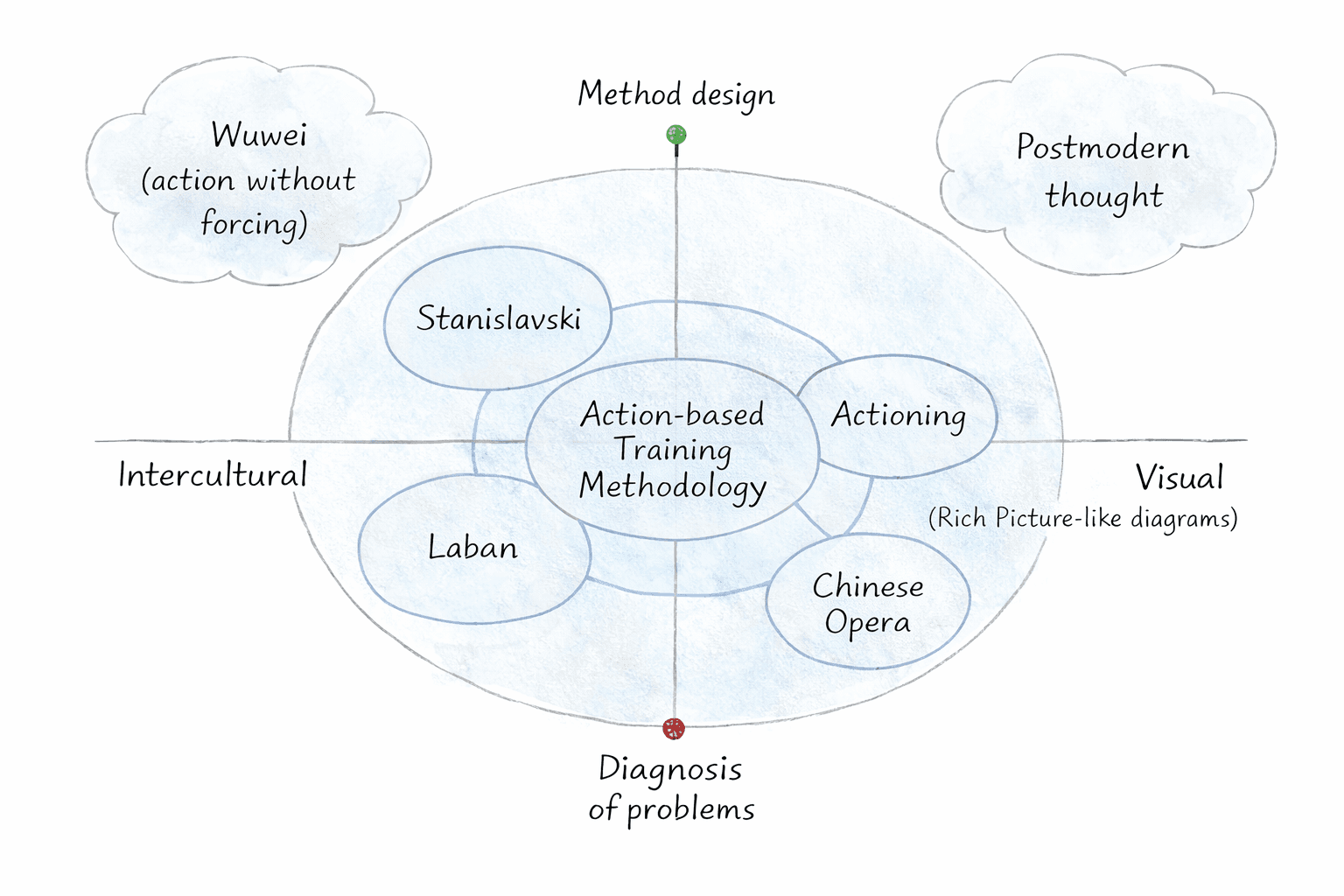
My methodology is grounded in action.
It synthesises Stanislavski, Actioning, Laban, and Chinese Opera, and is informed by
Western postmodern thought and the Daoist concept of Wuwei (action without forcing),
forming an intercultural framework for actor training.
To support diagnosis, method design, and articulation in training,
I have also developed Rich Picture–like diagrams, metaphors, and playful exploration as embodied cognitive tools,
so that what actors understand is taken in physically and stays with them in rehearsal and performance.
My methodology is grounded in action. It synthesises Stanislavski, Actioning, Laban, and Chinese Opera, and is informed by
Western postmodern thought and the Daoist concept of Wuwei (action without forcing), forming an intercultural framework for actor training.
To support diagnosis, method design, and articulation in training, I have also developed Rich Picture–like diagrams, metaphors, and playful exploration as embodied cognitive tools, so that what actors understand is taken in physically and stays with them in rehearsal and performance.
My methodology is grounded in action.
It synthesises Stanislavski, Actioning, Laban, and Chinese Opera, and is informed by Western postmodern thought and the Daoist concept of Wuwei (action without forcing), forming an intercultural framework for actor training.
To support diagnosis, method design, and articulation in training, I have also developed Rich Picture–like diagrams, metaphors, and playful exploration as embodied cognitive tools, so that what actors understand is taken in physically and stays with them in rehearsal and performance.
This work is documented through practice-as-research publications.
The intercultural training research received Second Prize at the International Theatre Academy Awards (2022) for methodological innovation, while the work on Rich Picture–like diagrams was described as 'a radical rethink of Stanislavski’s communication' (TDPT, 2024).
What this looks like in practice can be seen in the video below.
This work is documented through practice-as-research publications. The intercultural training research received Second Prize at the International Theatre Academy Awards (2022) for methodological innovation, while the work on Rich Picture–like diagrams was described as 'a radical rethink of Stanislavski’s communication' (TDPT, 2024).
What this looks like in practice can be seen in the video below.
This work is documented through practice-as-research publications. The intercultural training research received Second Prize at the International Theatre Academy Awards (2022) for methodological innovation, while the work on Rich Picture–like diagrams was described as 'a radical rethink of Stanislavski’s communication' (TDPT, 2024).
What this looks like in practice can be seen in the video below.
If you would like the longer story, you can start here.
If you would like the longer story,
you can start here.